




Explore the decades-long, remarkable efforts of the Papunya community to record language and culture and keep it alive.
Papunya is a remote Aboriginal community in the Western Desert region of the Northern Territory, and the birthplace of the internationally known Western Desert art movement.
Between 1979 and 1990, the Papunya Literature Production Centre (PLPC) produced hundreds of Pintupi-Luritja bilingual readers guided by the community’s Elders, among them pioneers of the Western Desert Art movement.
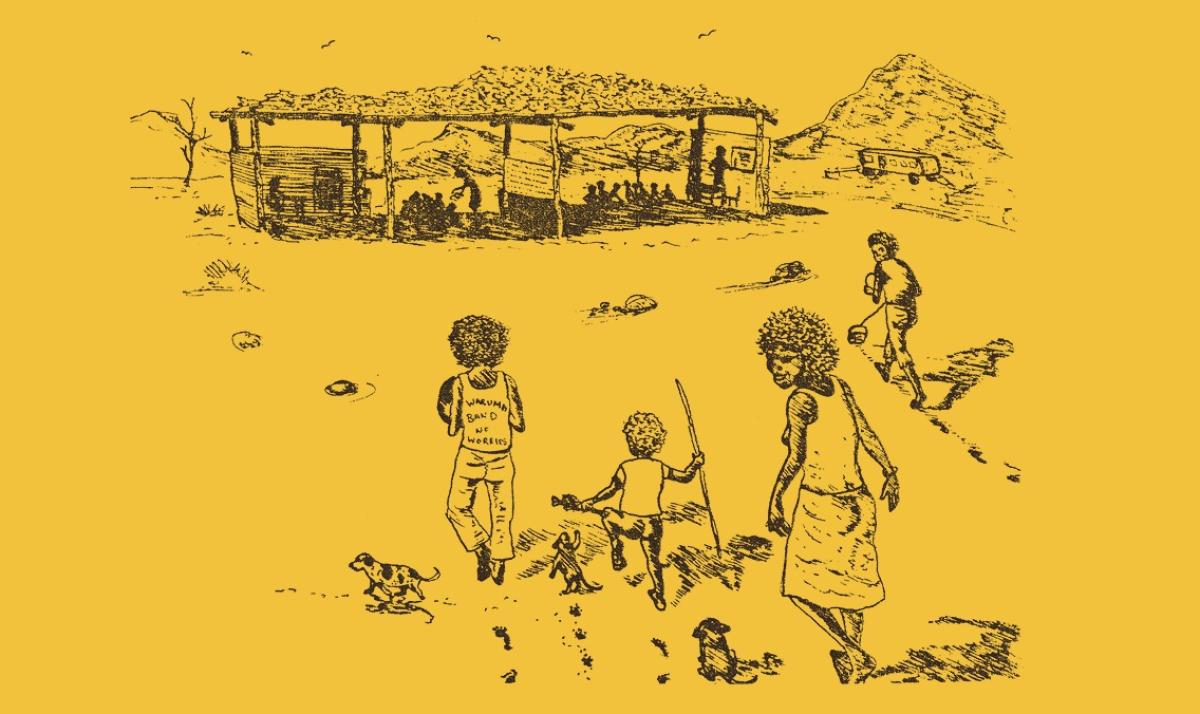
The readers – illustrated books – were produced as literacy tools for local schoolchildren and tell stories of first contact, Dreamings, community life, plants, animals and more. Some are funny and wildly creative. Others are moving, dramatic and extraordinary.
‘Wangka Wakaṉutja’ is Pintupi-Luritja for ‘the story has been told’.
In the 10-year period the PLPC was operating, we received more than 350 readers under legal deposit provisions where they have remained in safekeeping.
The exhibition, Wangka Wakaṉutja: The Story of the Papunya Literature Production Centre, brings the readers to life and builds on a recent exhibition on show at the Library and Archives NT in Darwin. It features stories, drawings, photographs, manuscripts, ephemera and oral histories from the collections of the Papunya community, Papunya School, National Library of Australia, Australian National University, and other private collections.
The exhibition is curated by Karen McDonald, Roslyn Dixon, Kuḻaṯa Dennis Nelson, Priscilla Brown, Charlotte Phillipus, Vivien Johnson, Samantha Disbray, Dr Guy Hansen, Allister Mills and Loris Gulliver.
A landmark publication from NLA Publishing, also titled Wangka Wakaṉutja: The Story of the Papunya Literature Production Centre, will be released simultaneously with the exhibition opening. It shares the overarching story of this important Aboriginal literary movement, powered by collective creativity and cultural pride and the remarkable story of the books they made, from their creation and use to their loss and rediscovery. The book includes fully illustrated recreations of several Papunya readers in Pintupi-Luritja language.
These stories are a small selection of hundreds created by Papunya authors and illustrators at the Papunya Literature Production Centre. They belong to the authors, their families, and the community of Papunya.
Learn more about the Pintupi-Luritja language, the exhibition, book, and read a selection of the Papunya readers online in Trove by visiting the National Library of Australia website.
The exhibition runs from 4 April to 11 October 2026 and is exclusive to Canberra.
Cultural Advisory Notice: Aboriginal and Torres Strait Islander people are advised that this exhibition contains a range of material which may be considered culturally sensitive, including the images and records of people who have passed away. Some material in the Library’s collections contains terms that reflect author’s views, or those of the period in which the item was written or recorded but may not be considered appropriate today. These views are not necessarily the views of the National Library of Australia. While the information may not reflect current understanding, it is provided in an historical context.
Image credit: Thomas Stevens, Illustration from Kantina, Kuula, Ngurra, 1985, nla.gov.au/nla.obj-3285322250